A JUPITER WITH 4.11:1 REAR AXLE
Many years ago, in my youth, I decided to install a Laycock de Normanville overdrive unit from a 1950s Humber Hawk into the Jupiter. The seed was sown at that first windswept, rain swept National Jowett Day in Bradford in 1966. I think it was George Mitchell and someone from the south who suggested an overdrive conversion. I took it all in and went home planning just how to do it. My Jupiter, then, was in a very rusted and rotted state, so a spot of butchering wouldn't matter! The job grew to the extent that I used the overdrive unit as a midship bearing and coupled it by a short shaft to a Sunbeam Rapier gearbox – having lifted the steering rack to make room.
During the car's most recent rebuild, I decided that it should be brought back as close to 'standard' as possible. Out went the Rapier gearbox and the overdrive soon followed it. Once the car was back on the road, it was again evident how low geared it seemed to be. This was particularly so on the long flat stretches so often encountered here. Something had to be done before the Jupiter was shipped to England for the Pitlochry and Le Mans events. I finally decided on a "Continental Touring" rear axle with a higher ratio.
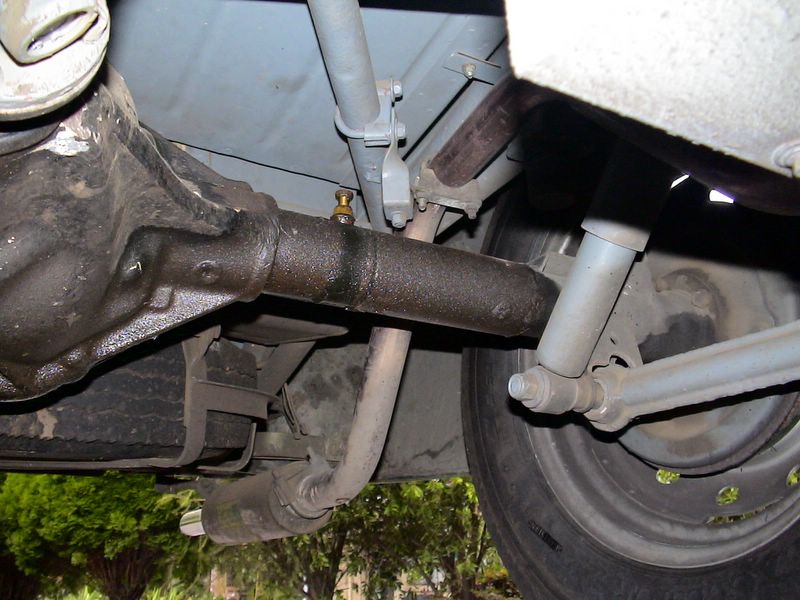
Just around the corner was a workshop that specialized in rear axle overhauls and conversions for hot rods and such. Initial investigation revealed that it was a simple matter to insert a modern differential assembly and retain the Jupiter hubs, brakes and suspension. The choice of differential was then discussed. It seemed that Nissan Bluebird vehicles provided a number of ratios to choose from, but they were not deemed to be reliable enough to handle the Jowett engine's torque characteristics! The final choice was a Ford Falcon differential from a XY Utility (pick-up), at 4.11:1. This was chosen for the following reasons:
It was made in Australia – none of that Japanese rubbish in my Jupiter!
It was fairly common.
It was stronger than the original Salisbury differential in the Jowett. For starters, there were four spider gears instead of two. Tractor experience told me that four spider gears were far more durable than two.
Visually it looked very similar to the original housing.
It was equipped with larger differential carrier bearings.
The installer was happy about it.
The rear axle assembly was removed from the Jupiter and taken to the installer, less brake drums. It was dismantled and straight away there was a telephone call. "How much work had the axle assembly done?" "Well over 100,000 miles", was my response. That figured, all of the Timken taper roller bearings were worn out, as was the crownwheel carrier. He was instructed to install new hub bearings and whatever was needed in the Ford part of it.
The actual conversion involved the following operations:
1. Detailed measurements of the original axle housing weld assembly. These were all written onto a plan drawing. Particular note was made of the Panhard rod bracket and the hand brake compensator bracket.
2. The axle housing weld assembly was then cut inboard of the rear suspension brackets and the centre was put to one side.
3. The same operation was carried out on the Ford housing.
4. A pair of sleeves were machined to accept the differing axle housing tube diameters. The tube ends and centre housing were pressed into these and welded.
5. This is where the first major problem arose, because the Jowett ends were welded upside down. The installer was good about it and rectified the concern – or so we thought.
6. The differential side gears from both axles were annealed so that they could be machined. The original Jupiter gears were machined to form a pair of splined sleeves. The Ford gears were machined to fit over the Jupiter sleeves.
7. The installer described the process of securing the machined gears to the splined sleeves as 'copperizing' – a process with which I am not familiar. It was guaranteed to cope with far more power and torque that the Jupiter could develop.
8. The gear/sleeve assemblies were then re-hardened ready for installation.
9. The axle was then assembled with new bearings and seals throughout.
10. The cost of the conversion was $A900.
After installing the modified axle assembly into the car, a test drive soon revealed that a 60 mph cruising speed could be enjoyed before propellor shaft vibration set in. It was noticed that second and third gears were really useable in traffic situations. Third gear was particularly pleasant. However, the gap between third gear and top gear was felt to be more pronounced. My Jupiter has a standard low ratio gearbox, and this feature will probably make for a longer life for bottom gear. On the flat, the car takes off happily in second gear from stationary.
It was time to ship the Jupiter to England, and it was while overseas that the driveline concern really raised its ugly head. After our extended tour to Scotland, the car was put on a hoist and the perceived cause of the concern was a loose universal joint at the rear. A new joint kit was installed and it was time to set off for Le Mans. It was here that the vibration became much more severe on the way back it was so bad that we thought, upon reaching the summit of the Pont du Nord over the Seine, we would be hurled over the edge! On the descent, things calmed down and all was reasonably OK till we reached Bristol.
The Jupiter was taken to a local garage, where it was MOT'd in 1963, and the cause of the vibration was revealed. The rear axle pinion shaft was 'nose' high and the angle between it and the front shaft assembly was very unequal. The vibration had also loosened the constant velocity joint at the gearbox end, which due to the housing's shape, could not have the securing split pin installed. My fault that one!
When the Jupiter arrived back home, it was taken to the rear axle conversion shop. He was amazed at how far out it was. The axle was removed right away and the two axle shafts etc removed. The tube joining sleeves were again cut free and the tube ends rotated to ensure that, with a plumb bob hung through the upper spring arm bush centre and the axle shaft centre line, the pinion shaft was set at 90° to the plum bob line. All of this was repaired at no charge to me.
This action calmed down the vibration somewhat, but did not cure it entirely. It was time to fix that for once and for ever. The shaft assembly was removed and taken to a reputable propeller shaft repairer. It had been entirely built for me by Hardy Spicer. The repairer found unacceptable runout, both vertical and axial at welded components. All of this was corrected and I can now cruise at 70 + miles per hour for miles on end. Recently the Jupiter put just over 100 kilometres into one hour, despite being held up by a couple of trucks along the way.
Would I do it all again?
I really wonder, and, having seen Tony George's installation, an overdrive would be more tempting. However, since the rear axle conversion, many miles have been covered at relaxed engine speeds. It does struggle up some hills, but if there is a good run at them – the performance in top gear is remarkably good. Fuel starvation not withstanding.
Mike Allfrey..
 My Jupiter now has the overdrive fitted and so does Barry Houstons car.Barry has driven to Perth.Adelaide,Tasmania,etc from Brisbane with no troubles.At 100 kph my car is doing about 3200 RPM and is a pleasure to drive.Brian Holmes did a lot of the work to fit these units with an adaptor plate and having the output shaft welded to suit.The cross member at the back of the g box needs to be cut but the new one is just as strong.
  With the long distances to cover in Australia to get to events,this makes the drive much easier on the car and driver.