I was recently on a site www.simoncars.co.uk & it has pictures of early & late Javelin badges.
Would it be possible for the club to do something similar showing the difference between early & late Javelins.
As everyone seems to find out they are not all the same.
Identification
-
David Kemp
- Posts: 641
- Joined: Sun Mar 09, 2008 1:18 pm
- Location: Brisbane ,Australia
Identification
Good memories of Bradfords.
-
Jack
- Posts: 1113
- Joined: Tue Mar 30, 2010 11:49 am
- Location: Herts
Re: Identification
Hi David,
Not sure if prompted by the discussion on the restoration thread, but probably worth us splitting this out. I agree, we need a guide if possible to the changes in models and years, presumably there is a cutoff at chassis no X for each change?
This discussion (http://www.jowett.net/forum/viewtopic.p ... &start=225) is on the boot handle, numberplate and light situation, but suggest we move it here, so perhaps we start at the back and work forwards, and once we have identified the differences we can put them into a guide in the gallery?
Perhaps a reasonable start, from the technical bulletins, and once we have consensus we can move to the changes at the front end, as there are not too many changes in appearance at the back end.
My original post from there:
Not sure if prompted by the discussion on the restoration thread, but probably worth us splitting this out. I agree, we need a guide if possible to the changes in models and years, presumably there is a cutoff at chassis no X for each change?
This discussion (http://www.jowett.net/forum/viewtopic.p ... &start=225) is on the boot handle, numberplate and light situation, but suggest we move it here, so perhaps we start at the back and work forwards, and once we have identified the differences we can put them into a guide in the gallery?
Perhaps a reasonable start, from the technical bulletins, and once we have consensus we can move to the changes at the front end, as there are not too many changes in appearance at the back end.
My original post from there:
Jack wrote:Some interesting research at this point around boot lids, light location, colour, numberplates, and everything else related to it throws up a few questions, hopefully with a bit of the knowledge on here we can ensure that there is a record of what the boot and numberplate arrangements should be for a car of a certain age. Perhaps.
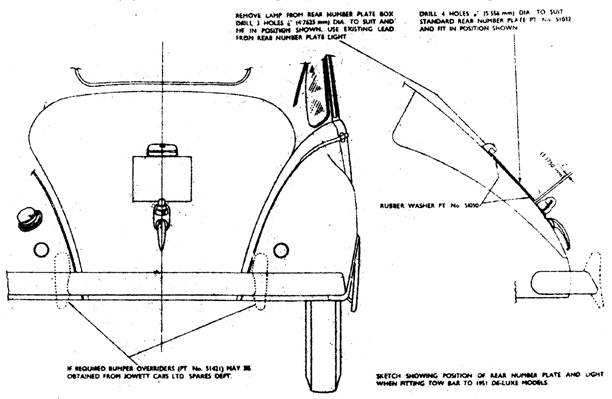
The image shows the various permutations of numberplate and light arrangement, though these are the instructions issued in May 1951 for towbar attachment on deluxe models it serves to show us what we are looking at and discussing.
The first change seems to happen in the Bulletin from Nov 1950: "The original number plate light and tail light glass has been modified to serve as a number plate light on the Standard model or as a reversing light on the Deluxe model, Part Number 51619. It should be noted that the new light glass is interchangeable on both models as it is possible to alter direction of the beam by turning the bulb holder 180°." - So Peter's Early Standard (pre Nov 1950) I think should have a white/red cone over the light, with the white pointing up to the numberplate and the red serving as a red tail light.
What I don't understand from the above, is that if the Standard from Nov 50 onwards had a plain white shroud (it says they are interchangeable) it would have a white light pointing backwards, even with the shroud around the bulb it doesn't seem right. Obviously not an issue on the deluxe, as it is only used as a reversing light, with the numberplate and light on the rear bumper.
I the same bulletin, it says of Deluxe models "A rear number plate box with an illuminating light has been fitted to the rear bumper blade." - I also don't know what happened before this point on Deluxe cars. Does anyone know? Did they have a numberplate and light that was somehow not boxed in?
Obviously at this point a reversing light switch was added to the gearbox on Deluxe cars, so that the white light could be illuminated when required.
The May 1951 Bulletin details towbar fitting on a deluxe, as in the image above, and the numberplate light above the numberplate light is fitted because the conical light on the handle is now a reversing light on deluxe cars, and the numberplate and light has been removed from the bumper. On a standard the numberplate is already out of the way and the conical light is now white and serves as numberplate light only so this isn't required.
This is the only change I can find in the Technical Bulletins. Does anyone know definitively when the "handle only" boot lids were used, where there is no conical light above the handle? I assume the light and numberplate were on the bumper, but that would mean no reversing or tail light other than the sidelights. Is this for later Standard models?
Jack.
-
robert lintott
- Posts: 353
- Joined: Sun Mar 02, 2008 12:29 am
- Your interest in the forum: Javelin E2PD 22752 D PHU317
Austin 16/6 tourer 1930
Ferrari 308 gt4 1978
Alfa Romeo Spider 2000 1978
Jaguar XJ6 diesel 2006 - Location: somerset uk
Re: Identification
It had occurred to me that there is value in identifying when changes were introduced to aid not only originality ideas but also help owners with replacements and modifications . Just what constitues originality in a 60+ year old surviving car may be a rather arid question and is one which has taxed the best minds in vintage /classic circles , especially the VSCC and VCC. We also must recognise that shop floor practice was not neccessarily as rigorous as the paperwork might indicate and parts were fitted as they came to hand .
I ,and I am sure others, have the Jowett Technical Bulletins nos 1to 125 for the Javelin and Jupiter which I consult from time to time. These were aimed at Dealers to help them make adjustments and replacements and to reinforce important maintenance procedures . Buried in these is some of the information some members are looking for , although much of it relates to engines where it is not possible to tell just what is inside . However I doubt if there are many suvivors with engines as fitted by the factory in their particular car so originality is not entirely relevant ! Were there any Bulletins beyond 125?
I would be prepared to go through the Bulletins and list the changes which cover appearance , engineering modifications etc and the dates of introduction . Unfortunately while most of these are dated by month and year almost all are specified by engine number rather than body number . While body numbers have a clear code and are quoted in our Register , engine numbers look the same but seem to follow different rules , and of course the engine number of a surviving car ranges from non existent to recon to a swap bitza.
Does anyone have factory records giving the original engine number associated with each body number ? If so we could at least match up the changes with the body numbers on our cars and in the register. Even the build dates for each body number would help.If not we have only the date of the Bulletin.
As an example of all this( see previous entries) the new horizontal bonnet motif and the diecast front grill were introduced from engine no EO PC 15631 ( which is definitely not a body number ) , according to Item 42 issued in May 1951 for the PC model.
Before starting this task, it would be helpful to have answers to the above questions , pitch in the experts ! Bob
I ,and I am sure others, have the Jowett Technical Bulletins nos 1to 125 for the Javelin and Jupiter which I consult from time to time. These were aimed at Dealers to help them make adjustments and replacements and to reinforce important maintenance procedures . Buried in these is some of the information some members are looking for , although much of it relates to engines where it is not possible to tell just what is inside . However I doubt if there are many suvivors with engines as fitted by the factory in their particular car so originality is not entirely relevant ! Were there any Bulletins beyond 125?
I would be prepared to go through the Bulletins and list the changes which cover appearance , engineering modifications etc and the dates of introduction . Unfortunately while most of these are dated by month and year almost all are specified by engine number rather than body number . While body numbers have a clear code and are quoted in our Register , engine numbers look the same but seem to follow different rules , and of course the engine number of a surviving car ranges from non existent to recon to a swap bitza.
Does anyone have factory records giving the original engine number associated with each body number ? If so we could at least match up the changes with the body numbers on our cars and in the register. Even the build dates for each body number would help.If not we have only the date of the Bulletin.
As an example of all this( see previous entries) the new horizontal bonnet motif and the diecast front grill were introduced from engine no EO PC 15631 ( which is definitely not a body number ) , according to Item 42 issued in May 1951 for the PC model.
Before starting this task, it would be helpful to have answers to the above questions , pitch in the experts ! Bob
-
Robin Fairservice
- Posts: 322
- Joined: Mon Feb 13, 2006 9:11 pm
- Your interest in the forum: Learning about Jowett cars
- Given Name: ROBIN
- Location: Prince George, BC, Canada
Re: Jowett Service Bulletins
In 2002, Bob Jones of the East Anglain Section edited a Jowett Owners Handbook, and this has all of the Service Bulletins grouped under the different parts of the car. This document is also available on the Jowett Org site and is in the Gallery, so you wpouldn't have to type everything, just copy and paste as appropriate.
-
David Morris
- Posts: 864
- Joined: Thu Feb 09, 2006 9:23 am
- Your interest in the forum: Jowett Javelins since 1964. Now a Jowett Stationary engine owner and club member since 1964.
- Given Name: David
- Location: Sunny Bristol
Re: Identification
Hi there,
Our Javelin is a 1952 Standard and the differences between models has always interested me.
I have dug out a reference to the Javelin models from an old Jowetteer and I have attached a fairly definitive report from Harry Brierly, who was the Club's Technical Information Officer. In this, Harry mentions that there were five models of Javelin produced. I think we can put some trust in this report, as it was written when the memories of those involved was fairly fresh and were drawn from personal experiences with the factory.
The terms 'Standard' and 'De Luxe' seem to appear in references to the two models produced from 1950 onwards. This would infer, I suggest, that Peter Pfister's car that we have seen being worked on in the UK and illustrated so well on JowettTalk, may not actually be a 'Standard', but falls into the pre-1950 model range where there was no such version offered by the factory. If you bought a Javelin before 1950, it was described as a Javelin with no second descriptor, and the split to two models came afterwards.
This infers that, in my view, we should really, for Concours purposes, have at least three classes, 'pre 1950', 'Standard' and 'De Luxe'?
I realise that, as Harry also mentions, the factory did 'mix and match' to a degree and I believe that there are almost no two Javelins the same!
I hope this helps?
All the best,
David
Our Javelin is a 1952 Standard and the differences between models has always interested me.
I have dug out a reference to the Javelin models from an old Jowetteer and I have attached a fairly definitive report from Harry Brierly, who was the Club's Technical Information Officer. In this, Harry mentions that there were five models of Javelin produced. I think we can put some trust in this report, as it was written when the memories of those involved was fairly fresh and were drawn from personal experiences with the factory.
The terms 'Standard' and 'De Luxe' seem to appear in references to the two models produced from 1950 onwards. This would infer, I suggest, that Peter Pfister's car that we have seen being worked on in the UK and illustrated so well on JowettTalk, may not actually be a 'Standard', but falls into the pre-1950 model range where there was no such version offered by the factory. If you bought a Javelin before 1950, it was described as a Javelin with no second descriptor, and the split to two models came afterwards.
This infers that, in my view, we should really, for Concours purposes, have at least three classes, 'pre 1950', 'Standard' and 'De Luxe'?
I realise that, as Harry also mentions, the factory did 'mix and match' to a degree and I believe that there are almost no two Javelins the same!
I hope this helps?
All the best,
David
You do not have the required permissions to view the files attached to this post.
-
paul wilks
- Posts: 398
- Joined: Fri Aug 04, 2006 11:13 pm
- Your interest in the forum: 1953 deluxe Javelin (NVM285) owned by father 1959-67
1949 standard Javelin (FBD327) owned in 1980s as daily transport
1952 deluxe Javelin (HJU592) owned since 1967 aka 'Yellow Peril' - Location: Runcorn, Cheshire
Re: Identification
Interesting stuff! My Javelin is a E2 PD (20229D- the D is for de-luxe) but it has the earlier suspension. Most E2 PDs I have come across seem to have the later suspension.
Paul
Paul
Paul Wilks
-
David Morris
- Posts: 864
- Joined: Thu Feb 09, 2006 9:23 am
- Your interest in the forum: Jowett Javelins since 1964. Now a Jowett Stationary engine owner and club member since 1964.
- Given Name: David
- Location: Sunny Bristol
Re: Identification
Hi Paul,
From the Javelin Club Handbook, the change to rubber-bushed front suspension is quoted as taking place at chassis number E2/PD. 21868.
Our black Javelin, DCB 246, has a chassis number of E2/PD/20893, so she would have left the factory with the original metal-bushed front suspension. However, she now has the later rubber-bushed front suspension. Must have been swapped at some stage, probably by Ken Lees in her competition days?
The suspensions can be swapped, there is a detailed method given in the Javelin Handbook. I swapped the suspensions over on a previous Javelin, VMG177, on the kerp-side back in the 1960's. Either Jack Moon or Keith Clements mentioned that they have noticed that there is a dished indent on the N/S inner wheel arch for the later front suspension top pivot pin. DCB 246 has this dent in the inner wing and I must have put a similar dished indent into VMG 177, although I have forgotten this through the mists of time?
Hope this helps?
All the best,
David
From the Javelin Club Handbook, the change to rubber-bushed front suspension is quoted as taking place at chassis number E2/PD. 21868.
Our black Javelin, DCB 246, has a chassis number of E2/PD/20893, so she would have left the factory with the original metal-bushed front suspension. However, she now has the later rubber-bushed front suspension. Must have been swapped at some stage, probably by Ken Lees in her competition days?
The suspensions can be swapped, there is a detailed method given in the Javelin Handbook. I swapped the suspensions over on a previous Javelin, VMG177, on the kerp-side back in the 1960's. Either Jack Moon or Keith Clements mentioned that they have noticed that there is a dished indent on the N/S inner wheel arch for the later front suspension top pivot pin. DCB 246 has this dent in the inner wing and I must have put a similar dished indent into VMG 177, although I have forgotten this through the mists of time?
Hope this helps?
All the best,
David
-
robert lintott
- Posts: 353
- Joined: Sun Mar 02, 2008 12:29 am
- Your interest in the forum: Javelin E2PD 22752 D PHU317
Austin 16/6 tourer 1930
Ferrari 308 gt4 1978
Alfa Romeo Spider 2000 1978
Jaguar XJ6 diesel 2006 - Location: somerset uk
Re: Identification
Hallo to David and Paul, Just to say that the number E2PD 21868 is the ENGINE number at which the change over to the rubber bushed suspension took place , according to the Technical Bulletin 96 of July 1952 . Whether this was the body number as well is not clear ,do you know if cars had the same body and engine number? . If the changeover took place in July 1952 then DCB , HJU and VMG registered earlier would certainly have had the earlier suspension . My three javelins were registered in late 1952 and early 1953 and all had /have the later type . Apart from lubrication do you think there is any advantage in the later type ? good hunting Bob
-
robert lintott
- Posts: 353
- Joined: Sun Mar 02, 2008 12:29 am
- Your interest in the forum: Javelin E2PD 22752 D PHU317
Austin 16/6 tourer 1930
Ferrari 308 gt4 1978
Alfa Romeo Spider 2000 1978
Jaguar XJ6 diesel 2006 - Location: somerset uk
Re: Identification
For David , There is evidence to support your definition of Standard and Deluxe . Technical Bulletin 33 issued in November 1950 announces the introduction of the 1951 Javelin , from Engine No EO PC 11326, C being the letter for 1951 models . It goes on to describe the introduction of the new Deluxe model . Both models then had the larger headlamps ,the deluxe having a reversing light on the boot lid, a number plate box on the rear bumper and two ash trays let in to the horizontal surface of the facia. There is no reference to the plain bumpers nor to the walnut facia . It is fair to assume these deluxe models were available from the October 1950 Motor Show . Bob
-
David Kemp
- Posts: 641
- Joined: Sun Mar 09, 2008 1:18 pm
- Location: Brisbane ,Australia
Re: Identification
At the next Jowett get together,could someone line up a early PA to PE & photograph the fronts & rears.
And interiors if there is a difference...as well as side if there is a difference. Restored cars magazine has done this for other cars & it is very interesting to see subtle & not so subtle changes.
And interiors if there is a difference...as well as side if there is a difference. Restored cars magazine has done this for other cars & it is very interesting to see subtle & not so subtle changes.
Good memories of Bradfords.
-
David Morris
- Posts: 864
- Joined: Thu Feb 09, 2006 9:23 am
- Your interest in the forum: Jowett Javelins since 1964. Now a Jowett Stationary engine owner and club member since 1964.
- Given Name: David
- Location: Sunny Bristol
Re: Identification
Hi Robert,
Well spotted! You are absolutely right that the Jowett Factory engineering change notices refer to ENGINE numbers as defining when changes were introduced, even when those changes refer to bodywork, brakes etc. I hadn't spotted the difference and made the assumption that they were refering to chassis numbers.
I have the original buff log book for NKJ 352 and the numbers quoted there (on 12th October 1950!) state that the chassis number is EO/PB/10866/D and it shows the same number for the engine. I wonder if the engine and chassis were stamped on the production line?
Of course, over time I guess the majority of Javelins will be showing different numbers for the chassis and engine, as us Jowetteers have a habit of swapping engines almost on a yearly basis? I know that DCB 246 has a chassis number of E2/PD/20893 but an engine number of E3/PE/35xxx ( cannot recall the exact number without rushing out to the garage this morning! )
All the best,
David
PS, Will you be coming to the Bristol Classic show next weekend...hope to see you there?
Well spotted! You are absolutely right that the Jowett Factory engineering change notices refer to ENGINE numbers as defining when changes were introduced, even when those changes refer to bodywork, brakes etc. I hadn't spotted the difference and made the assumption that they were refering to chassis numbers.
I have the original buff log book for NKJ 352 and the numbers quoted there (on 12th October 1950!) state that the chassis number is EO/PB/10866/D and it shows the same number for the engine. I wonder if the engine and chassis were stamped on the production line?
Of course, over time I guess the majority of Javelins will be showing different numbers for the chassis and engine, as us Jowetteers have a habit of swapping engines almost on a yearly basis? I know that DCB 246 has a chassis number of E2/PD/20893 but an engine number of E3/PE/35xxx ( cannot recall the exact number without rushing out to the garage this morning! )
All the best,
David
PS, Will you be coming to the Bristol Classic show next weekend...hope to see you there?
-
Forumadmin
- Site Admin
- Posts: 20676
- Joined: Tue Feb 07, 2006 5:18 pm
- Your interest in the forum: Not a lot!
- Given Name: Forum
Engine number and chassis number. Metal v rubber
Any car that has the same engine number and chassis number is doing well. But the general rule, I thought, was that they were the same when they left the factory. Obviously, knowing Jowetts, that 'rule' must have been broken at some time.
Many cars went back for new or reconditioned engines at the factory or in Jowett engineering. Most of these would carry RO numbers but maybe a 'new' engine might have been stamped with the chassis number. Clearly that option is open to all so look carefully at the stamping on the block to check it has not been refaced.
Over the years most engines would have had modifications anyway as well as new or second hand parts fitted from other engines.
As for the body and chassis the same will be true. My Javelin was converted in the 50s by the owner to a deluxe as well as having every possible modification to improve its performance . So what rules do you apply if that is to be judged in the concours?
Metal v Rubber
There is no doubt a well set up metal suspension is more accurate than the rubber, but you have to grease it EVERY 500 miles and keep the oil reservoir topped up. Rubber is much more forgiving on the maintenance side. Some have tried nylon or polyurethane bushes that offers a compromise.
Peter's Javelin has been modified to be a combination of both with rubber at top and bottom of king pin but metal and oil in the upper link.
Many cars went back for new or reconditioned engines at the factory or in Jowett engineering. Most of these would carry RO numbers but maybe a 'new' engine might have been stamped with the chassis number. Clearly that option is open to all so look carefully at the stamping on the block to check it has not been refaced.
Over the years most engines would have had modifications anyway as well as new or second hand parts fitted from other engines.
As for the body and chassis the same will be true. My Javelin was converted in the 50s by the owner to a deluxe as well as having every possible modification to improve its performance . So what rules do you apply if that is to be judged in the concours?
Metal v Rubber
There is no doubt a well set up metal suspension is more accurate than the rubber, but you have to grease it EVERY 500 miles and keep the oil reservoir topped up. Rubber is much more forgiving on the maintenance side. Some have tried nylon or polyurethane bushes that offers a compromise.
Peter's Javelin has been modified to be a combination of both with rubber at top and bottom of king pin but metal and oil in the upper link.
-
David Morris
- Posts: 864
- Joined: Thu Feb 09, 2006 9:23 am
- Your interest in the forum: Jowett Javelins since 1964. Now a Jowett Stationary engine owner and club member since 1964.
- Given Name: David
- Location: Sunny Bristol
Re: Identification
Hi Robert,
Interesting! Your comment about the De-Luxe being availlable from October 1950 is very relevant. our De Luxe Javelin, NKJ 352, has a chassis number EO/PB/10866/D and was registered on 12th October 1950! Maybe the original owner bought her just after the show? However, she has the small headlamps, a reversing light on the boot lid, no number plate box on the rear bumper ( it's on the boot lid ), the walnut facia and two ash trays let in to the front side cards.The bumpers are the heavier de-luxe type. The first owner must have probably worked for MoD ( Navy) as he exported her to Malta, and coated the underside with what looks like ship's anti-fouling black pitch!
All the best,
David
Interesting! Your comment about the De-Luxe being availlable from October 1950 is very relevant. our De Luxe Javelin, NKJ 352, has a chassis number EO/PB/10866/D and was registered on 12th October 1950! Maybe the original owner bought her just after the show? However, she has the small headlamps, a reversing light on the boot lid, no number plate box on the rear bumper ( it's on the boot lid ), the walnut facia and two ash trays let in to the front side cards.The bumpers are the heavier de-luxe type. The first owner must have probably worked for MoD ( Navy) as he exported her to Malta, and coated the underside with what looks like ship's anti-fouling black pitch!
All the best,
David
-
robert lintott
- Posts: 353
- Joined: Sun Mar 02, 2008 12:29 am
- Your interest in the forum: Javelin E2PD 22752 D PHU317
Austin 16/6 tourer 1930
Ferrari 308 gt4 1978
Alfa Romeo Spider 2000 1978
Jaguar XJ6 diesel 2006 - Location: somerset uk
Re: Identification
for David , Having read Harry Brierly's paper I think I may have misinterpreted Bulletin 33 and the timing of the introduction of Deluxe models . He says the single model was manufactured only in 1949 and that deluxe models were available from 1950 onwards , ie EO PB cars. Re- reading Bulletin 33 in the light of this, it does seem to describe changes to the Deluxe and Standard models rather than being just the introduction of the Deluxe. The changes included larger headlamps which is why a 1950 deluxe has, along with the standards in the same year, the smaller lamps . Sorry for any confusion Bob
-
Forumadmin
- Site Admin
- Posts: 20676
- Joined: Tue Feb 07, 2006 5:18 pm
- Your interest in the forum: Not a lot!
- Given Name: Forum
Re: Identification
I was discussing with Jack last night and we came to the conclusion that we should construct a history of pictures of these changes. We also need to explain any anomalies or uncertainties. Most cars have a chequered history. Although our Javelin had only one owner from new, that owner did lots of things to it. It is impossible to be certain that nothing has changed on a car. We recently viewed a car in a garage that had lain there since the early 60's. It probably was in its original state but was too far gone to save. Even so it had done 40000 miles and would have been 10 years old when laid up. Plenty enough time to get some changes.
What is really useful information are pictures of cars coming off the production line, and of cars in their first year of life. So dig them out!
What is really useful information are pictures of cars coming off the production line, and of cars in their first year of life. So dig them out!