Can anyone remind me please of the procedure for removing the rear brake drums? I have a correct style of hub puller.
Do you have to release the brake shoes (as on the front hubs) via the brake adjuster? And then is it simply a case of removing the split pin and the nut and removing the hub using the hub puller?
Thanks
Paul
Javelin rear brakes
-
paul wilks
- Posts: 398
- Joined: Fri Aug 04, 2006 11:13 pm
- Your interest in the forum: 1953 deluxe Javelin (NVM285) owned by father 1959-67
1949 standard Javelin (FBD327) owned in 1980s as daily transport
1952 deluxe Javelin (HJU592) owned since 1967 aka 'Yellow Peril' - Location: Runcorn, Cheshire
-
David Morris
- Posts: 864
- Joined: Thu Feb 09, 2006 9:23 am
- Your interest in the forum: Jowett Javelins since 1964. Now a Jowett Stationary engine owner and club member since 1964.
- Given Name: David
- Location: Sunny Bristol
Javelin Rear Brakes
Hi Paul,
Pat's advice is absolutely correct. It's a good idea to slacken off the adjuster anyway. All I can add is to have a copper hammer ready and give the drum a tapping as you apply pressure, to discourage the shoes from 'picking -up' on the drum and tilting as it starts to move. Be prepared to have to apply quite a lot of pressure if the drums have not been off for a while.
My old puller is home made and fits on the wheel studs. You can then leave the axle nut on the threads, having slackened it, and when the drum starts to move, it doesn't go far. However, I believe you are using the official Jowett tool which fits on the outer thread on the hub and needs the axle nut to be taken off to fit the tool? If this is the case for you, it might be useful to have something sacrificial, like an old disc of metal ( dare I say an old copper coin, obviously of foreign origin! ) to go between the end of the puller screw and the end of the axle shaft. Then the disc takes the punishment, not the shaft end.
Also, stand well clear when the drum does pop off, as it can travel quite a way! Something on the ground to cushion it if it falls off might be useful as well. The drum plus the puller weighs quite a lot.
Best of luck!
Regards,
David
Pat's advice is absolutely correct. It's a good idea to slacken off the adjuster anyway. All I can add is to have a copper hammer ready and give the drum a tapping as you apply pressure, to discourage the shoes from 'picking -up' on the drum and tilting as it starts to move. Be prepared to have to apply quite a lot of pressure if the drums have not been off for a while.
My old puller is home made and fits on the wheel studs. You can then leave the axle nut on the threads, having slackened it, and when the drum starts to move, it doesn't go far. However, I believe you are using the official Jowett tool which fits on the outer thread on the hub and needs the axle nut to be taken off to fit the tool? If this is the case for you, it might be useful to have something sacrificial, like an old disc of metal ( dare I say an old copper coin, obviously of foreign origin! ) to go between the end of the puller screw and the end of the axle shaft. Then the disc takes the punishment, not the shaft end.
Also, stand well clear when the drum does pop off, as it can travel quite a way! Something on the ground to cushion it if it falls off might be useful as well. The drum plus the puller weighs quite a lot.
Best of luck!
Regards,
David
-
Keith Clements
- websitedesign
- Posts: 3974
- Joined: Wed Feb 08, 2006 11:22 am
- Your interest in the forum: Jup NKD 258, the most widely travelled , raced and rallied Jowett.
- Given Name: Keith
- Contact:
Check for wear on the taper, also look at the notes on brakes on Jowettnet. http://jowett.org/jowettnet/dt/tech/bra ... brakes.htm
skype = keithaclements ;
-
paul wilks
- Posts: 398
- Joined: Fri Aug 04, 2006 11:13 pm
- Your interest in the forum: 1953 deluxe Javelin (NVM285) owned by father 1959-67
1949 standard Javelin (FBD327) owned in 1980s as daily transport
1952 deluxe Javelin (HJU592) owned since 1967 aka 'Yellow Peril' - Location: Runcorn, Cheshire
Javelin rear brakes
Thanks for the advice so far. Now here is a really STUPID question but you should be used to that from me by now! 
Having taken off the wheel, removed the locknut and slackened off the brakes, how do you remove the hub using the puller when everything wants to turn in unison? Do you have to start by adjusting the brakes so they grip the hub and then slacken off when you get the hub moving off the axle? Or do you have to try to remove that rectangular key first from the keyway? And if you do how do you remove it? Does it just pull out?
Questions! Questions! Questions!
Paul
PS
I have a PD model with the full hydraulic brakes. And I have a home made hub puller like the 'proper' Jowett one which screws on to the threaded end of the hub and then a central screw which acts on the end of the axle shaft. Does all that make sense?
Having taken off the wheel, removed the locknut and slackened off the brakes, how do you remove the hub using the puller when everything wants to turn in unison? Do you have to start by adjusting the brakes so they grip the hub and then slacken off when you get the hub moving off the axle? Or do you have to try to remove that rectangular key first from the keyway? And if you do how do you remove it? Does it just pull out?
Questions! Questions! Questions!
Paul
PS
I have a PD model with the full hydraulic brakes. And I have a home made hub puller like the 'proper' Jowett one which screws on to the threaded end of the hub and then a central screw which acts on the end of the axle shaft. Does all that make sense?
-
paul wilks
- Posts: 398
- Joined: Fri Aug 04, 2006 11:13 pm
- Your interest in the forum: 1953 deluxe Javelin (NVM285) owned by father 1959-67
1949 standard Javelin (FBD327) owned in 1980s as daily transport
1952 deluxe Javelin (HJU592) owned since 1967 aka 'Yellow Peril' - Location: Runcorn, Cheshire
Javelin rear brakes
Thanks everyone for your advice to date. It is greatly appreciated.
I followed your instructions, Pat, and the hub came off without too much trouble. Phew and thanks!
Although there is some rust inside, the whole thing seems very dry and free from any oily deposits (thankfully!)
Now another few questions! (Sorry)
• My brake shoes need replacing. I guess JCC Spares is the best place to go (?)
• What is meant by taking care not to fit the shoes upside down? It is difficult to explain in words but my shoes have linings which do not cover the whole of the metal shoe i.e. there is a gap between the end of the metal shoe and the start of the lining. The lining then covers the shoe fully to the 'other end'. On my car (the rear offside wheel) the top shoe was fitted with this ‘gap’ to the rear of the car (i.e. to the left of the hub). The bottom shoe was fitted with the gap to the front of the car (the right of the hub). Was this correct?
• And those two springs. Again on my rear offside wheel the yellow one was on the left (i.e. the rear of the car) and the green one was of the right (the front of the car. Is this correct? And how does the rear nearside hub differ?
Thanks to all of you for your patience.
Paul
I followed your instructions, Pat, and the hub came off without too much trouble. Phew and thanks!
Although there is some rust inside, the whole thing seems very dry and free from any oily deposits (thankfully!)
Now another few questions! (Sorry)
• My brake shoes need replacing. I guess JCC Spares is the best place to go (?)
• What is meant by taking care not to fit the shoes upside down? It is difficult to explain in words but my shoes have linings which do not cover the whole of the metal shoe i.e. there is a gap between the end of the metal shoe and the start of the lining. The lining then covers the shoe fully to the 'other end'. On my car (the rear offside wheel) the top shoe was fitted with this ‘gap’ to the rear of the car (i.e. to the left of the hub). The bottom shoe was fitted with the gap to the front of the car (the right of the hub). Was this correct?
• And those two springs. Again on my rear offside wheel the yellow one was on the left (i.e. the rear of the car) and the green one was of the right (the front of the car. Is this correct? And how does the rear nearside hub differ?
Thanks to all of you for your patience.
Paul
-
paul wilks
- Posts: 398
- Joined: Fri Aug 04, 2006 11:13 pm
- Your interest in the forum: 1953 deluxe Javelin (NVM285) owned by father 1959-67
1949 standard Javelin (FBD327) owned in 1980s as daily transport
1952 deluxe Javelin (HJU592) owned since 1967 aka 'Yellow Peril' - Location: Runcorn, Cheshire
Javelin rear brakes
Thanks Pat.
And what about the different coloured springs?
Should the yellow one be on the left on the rear offside wheel (i.e. to the rear of the car) and the green one on the right (the front of the car)?
And what about the nearside wheel? Is this reversed ie yellow on the right (to the rear) and green on the left (to the front)?
Thanks
Paul
And what about the different coloured springs?
Should the yellow one be on the left on the rear offside wheel (i.e. to the rear of the car) and the green one on the right (the front of the car)?
And what about the nearside wheel? Is this reversed ie yellow on the right (to the rear) and green on the left (to the front)?
Thanks
Paul
-
Mike Allfrey
- Posts: 491
- Joined: Thu Apr 06, 2006 10:14 am
- Your interest in the forum: It is a good vehicle for getting Jowett information to others.
- Given Name: Michael
- Location: Melbourne, AUSTRALIA.
G'dday From The Sunny South,
Melbourne today was juust what all northerners dream about - those north of Watford of course!
I have read through most of this topic and have not noted a couple of very valid points:
Point 1.
With a rotary wire brush in a high speed drill, work at removing paint and rust from the male thread on the brake drum. Doing this will make it much easier to screw the puller on to the drum to get an effective purchase.
Point 2.
The finish at the male and female tapers must be absolutely clean, free from paint, rust and grease. There must also be no grease present during assembly - just bright metal. A joint such as this, correctly assembled, will easily transmit over 200 horsepower, without a key!
A further note - after initial tightening of the axle shaft nut, use a hollow drift, with a heavy hammer, to seat the taper joint. Don't worry too much about the rear hub bearing. There would be a 99.99989 percent chance that the bearing has well and truly passed its use-by date!
After tightening the axle shaft nut dead tight, tighten even further to set the split pin hole with the slots in the nut.
Some have been known to advocate, in club newsletters, slacking off the nut to gain split pin access. But then they do not have a clue about such matters. The main trouble is that people actually believe them!!
Our axle shafts and brake drums are far too valuable to loose them through such thoroughly stupid practices.
All the best with your project,
Mike Allfrey.
Melbourne today was juust what all northerners dream about - those north of Watford of course!
I have read through most of this topic and have not noted a couple of very valid points:
Point 1.
With a rotary wire brush in a high speed drill, work at removing paint and rust from the male thread on the brake drum. Doing this will make it much easier to screw the puller on to the drum to get an effective purchase.
Point 2.
The finish at the male and female tapers must be absolutely clean, free from paint, rust and grease. There must also be no grease present during assembly - just bright metal. A joint such as this, correctly assembled, will easily transmit over 200 horsepower, without a key!
A further note - after initial tightening of the axle shaft nut, use a hollow drift, with a heavy hammer, to seat the taper joint. Don't worry too much about the rear hub bearing. There would be a 99.99989 percent chance that the bearing has well and truly passed its use-by date!
After tightening the axle shaft nut dead tight, tighten even further to set the split pin hole with the slots in the nut.
Some have been known to advocate, in club newsletters, slacking off the nut to gain split pin access. But then they do not have a clue about such matters. The main trouble is that people actually believe them!!
Our axle shafts and brake drums are far too valuable to loose them through such thoroughly stupid practices.
All the best with your project,
Mike Allfrey.
E0 SA 42R; Rover 75
-
paul wilks
- Posts: 398
- Joined: Fri Aug 04, 2006 11:13 pm
- Your interest in the forum: 1953 deluxe Javelin (NVM285) owned by father 1959-67
1949 standard Javelin (FBD327) owned in 1980s as daily transport
1952 deluxe Javelin (HJU592) owned since 1967 aka 'Yellow Peril' - Location: Runcorn, Cheshire
Javelin rear brakes
Thanks so far everyone but can I ask again please......
• Should the yellow one be on the left on the rear offside wheel (i.e. to the rear of the car) and the green one on the right (the front of the car)?
• And what about the nearside wheel? Is this reversed i.e. yellow on the right (to the rear) and green on the left (to the front)?
• Or doesn't it matter as long as you have different colours on each wheel (and I can't believe that about the Javelin)
Thanks for your patience!
Paul
• Should the yellow one be on the left on the rear offside wheel (i.e. to the rear of the car) and the green one on the right (the front of the car)?
• And what about the nearside wheel? Is this reversed i.e. yellow on the right (to the rear) and green on the left (to the front)?
• Or doesn't it matter as long as you have different colours on each wheel (and I can't believe that about the Javelin)
Thanks for your patience!
Paul
-
Mike Allfrey
- Posts: 491
- Joined: Thu Apr 06, 2006 10:14 am
- Your interest in the forum: It is a good vehicle for getting Jowett information to others.
- Given Name: Michael
- Location: Melbourne, AUSTRALIA.
G'dday From A Slightly Cloudy South,
With reference to the brake spring issue - somewhere in the JCC Archive there must be a copy of a Girling Bulletin, which shows very well the front and rear brake arrangement.
I have a copy of the Bulletin for the Hydro-mechanical brake system. But I don't have the one for the full hydraulic brake system. Maybe New Zealand can help?
Regards,
Mike Allfrey.
With reference to the brake spring issue - somewhere in the JCC Archive there must be a copy of a Girling Bulletin, which shows very well the front and rear brake arrangement.
I have a copy of the Bulletin for the Hydro-mechanical brake system. But I don't have the one for the full hydraulic brake system. Maybe New Zealand can help?
Regards,
Mike Allfrey.
E0 SA 42R; Rover 75
-
Mike Allfrey
- Posts: 491
- Joined: Thu Apr 06, 2006 10:14 am
- Your interest in the forum: It is a good vehicle for getting Jowett information to others.
- Given Name: Michael
- Location: Melbourne, AUSTRALIA.
G'dday From The Dark South,
Have found my Girling full hydraulic brake informatiion.
Looking at the driver's side (RHD) rear brake assembly, with the drum removed, the lower spring is GREEN and the upper spring is YELLOW.
Looking at the front passenger side (RHD) the extra hole, in the pitch circle diameter for the back plate mounting holes, should be at the bottom. The front brake back plates are handed i.e. there is a Rh and a LH plate. This is the easy way to identify the attitude of the back plate. In addition, the bleed screws should be fitted into the front upper hole in the wheel cylinder. The front wheel cylinder pushes the lower brake shoe down.
Both front brake shoe return springs are the same and, from memory are painted black.
Hope this helps.
Mike Allfrey.
Have found my Girling full hydraulic brake informatiion.
Looking at the driver's side (RHD) rear brake assembly, with the drum removed, the lower spring is GREEN and the upper spring is YELLOW.
Looking at the front passenger side (RHD) the extra hole, in the pitch circle diameter for the back plate mounting holes, should be at the bottom. The front brake back plates are handed i.e. there is a Rh and a LH plate. This is the easy way to identify the attitude of the back plate. In addition, the bleed screws should be fitted into the front upper hole in the wheel cylinder. The front wheel cylinder pushes the lower brake shoe down.
Both front brake shoe return springs are the same and, from memory are painted black.
Hope this helps.
Mike Allfrey.
E0 SA 42R; Rover 75
-
Mike Allfrey
- Posts: 491
- Joined: Thu Apr 06, 2006 10:14 am
- Your interest in the forum: It is a good vehicle for getting Jowett information to others.
- Given Name: Michael
- Location: Melbourne, AUSTRALIA.
Dear Pat,
Oh dear!
I thought that a PD Javelin was the subject of the original question. Full hydraulic.
Of course, I should not have said upper and lower springs. The spring closest to the brake adjuster assembly should be GREEN and the spring closest to the wheel cylinder should be YELLOW. From memory the springs are at an angle.
Will let you know when I re-line trhe rear brakes!
Regards,
Mike Allfrey.
Oh dear!
I thought that a PD Javelin was the subject of the original question. Full hydraulic.
Of course, I should not have said upper and lower springs. The spring closest to the brake adjuster assembly should be GREEN and the spring closest to the wheel cylinder should be YELLOW. From memory the springs are at an angle.
Will let you know when I re-line trhe rear brakes!
Regards,
Mike Allfrey.
E0 SA 42R; Rover 75
-
Keith Clements
- websitedesign
- Posts: 3974
- Joined: Wed Feb 08, 2006 11:22 am
- Your interest in the forum: Jup NKD 258, the most widely travelled , raced and rallied Jowett.
- Given Name: Keith
- Contact:
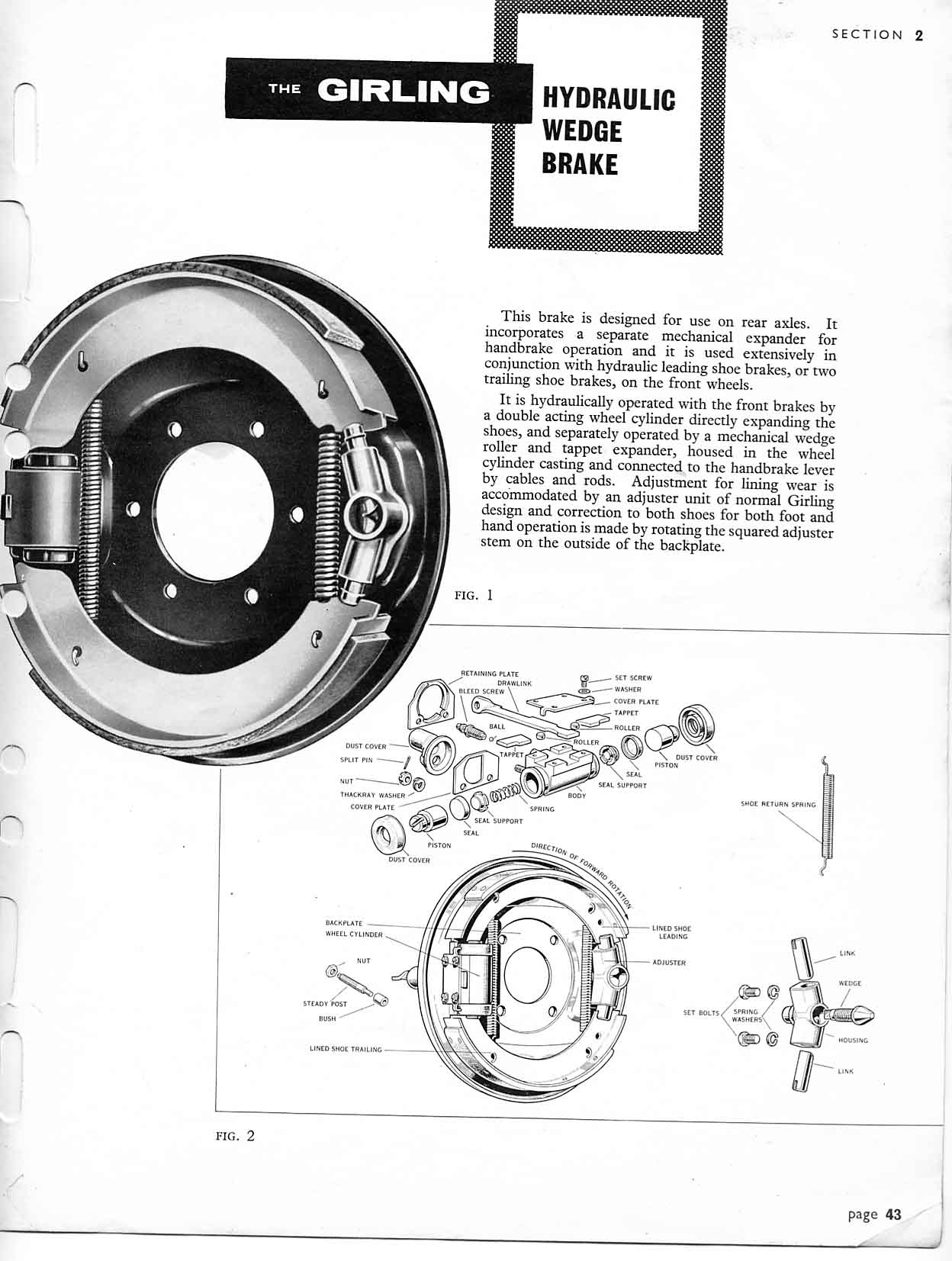
I hate to say this again; but did you not go to the Jowett page with all the Girling bulletins that I pointed to above?
http://jowett.org/jowettnet/dt/tech/brakes/br-hw1.jpg
http://jowett.org/jowettnet/dt/tech/brakes/br-hw1.jpg
skype = keithaclements ;
-
paul wilks
- Posts: 398
- Joined: Fri Aug 04, 2006 11:13 pm
- Your interest in the forum: 1953 deluxe Javelin (NVM285) owned by father 1959-67
1949 standard Javelin (FBD327) owned in 1980s as daily transport
1952 deluxe Javelin (HJU592) owned since 1967 aka 'Yellow Peril' - Location: Runcorn, Cheshire
Javelin rear brakes
Although there was no sign of leaking I decided to replace the rear brake cylinders and the brake shoes (which were pretty poor).
I ordered the brake shoes on Monday from JCC spares. They arrived on Wednesday! What service!!
I have ordered rear brake cylinders and yellow and green springs from Bill Lock via email. On my car, on the rear offside wheel the yellow one was on the left (i.e. the rear of the car) and the green one was of the right (the front of the car. And with the rear nearside the yellow spring was to the right (rear of car) and the green to the left (front of car).
Thankfully this agrees with Mike's summary- i.e.
The spring closest to the brake adjuster assembly should be GREEN and the spring closest to the wheel cylinder should be YELLOW.
Just to confirm I DO have a PD with full hydraulic brakes.
I think I'm getting there- wherever 'there' is!
Thanks as ever
Paul
I ordered the brake shoes on Monday from JCC spares. They arrived on Wednesday! What service!!
I have ordered rear brake cylinders and yellow and green springs from Bill Lock via email. On my car, on the rear offside wheel the yellow one was on the left (i.e. the rear of the car) and the green one was of the right (the front of the car. And with the rear nearside the yellow spring was to the right (rear of car) and the green to the left (front of car).
Thankfully this agrees with Mike's summary- i.e.
The spring closest to the brake adjuster assembly should be GREEN and the spring closest to the wheel cylinder should be YELLOW.
Just to confirm I DO have a PD with full hydraulic brakes.
I think I'm getting there- wherever 'there' is!
Thanks as ever
Paul
-
Mike Allfrey
- Posts: 491
- Joined: Thu Apr 06, 2006 10:14 am
- Your interest in the forum: It is a good vehicle for getting Jowett information to others.
- Given Name: Michael
- Location: Melbourne, AUSTRALIA.
Dear Paul and Pat Et Al,
It is wonderful to see in print that my summary was right - better show it to Sue!
Pat, we need to have a broader outlook when we look at a Girling diagram, Girling made brake assemblies for many British motor houses. Their literature often showed an example of the brake assembly that had the correct general arrangement of cylinders, adjusters, shoes and springs, the illustration is a guide only. Some back plates had eight, six and even five holes. We all know that the Jowett used four holes to attach the back plates.
I have a distinct aversion to Left and Right references when working on a motor vehicle. In the tractor trade we had a reference that said "Left and Right are as viewed when sitting in the driver's seat, looking forwards". Thus anything at the side of the machine was front or rear - never Left or Right.
I am preparing a Technical Notes Series chapter on the full hydraulic braking system. I will post it to Keith for addition to the notes he already has.
Incidentally, some Lucas control box training notes referred to a control box in a car - I knew straight away that it was on a Ferguson tractor! But it didn't matter.
Paul, 'THERE' is a wonderful place and a Jowett will certainly get you there - with many interesting occurrences along the way!
Regards,
Mike Allfrey.
It is wonderful to see in print that my summary was right - better show it to Sue!
Pat, we need to have a broader outlook when we look at a Girling diagram, Girling made brake assemblies for many British motor houses. Their literature often showed an example of the brake assembly that had the correct general arrangement of cylinders, adjusters, shoes and springs, the illustration is a guide only. Some back plates had eight, six and even five holes. We all know that the Jowett used four holes to attach the back plates.
I have a distinct aversion to Left and Right references when working on a motor vehicle. In the tractor trade we had a reference that said "Left and Right are as viewed when sitting in the driver's seat, looking forwards". Thus anything at the side of the machine was front or rear - never Left or Right.
I am preparing a Technical Notes Series chapter on the full hydraulic braking system. I will post it to Keith for addition to the notes he already has.
Incidentally, some Lucas control box training notes referred to a control box in a car - I knew straight away that it was on a Ferguson tractor! But it didn't matter.
Paul, 'THERE' is a wonderful place and a Jowett will certainly get you there - with many interesting occurrences along the way!
Regards,
Mike Allfrey.
E0 SA 42R; Rover 75
-
paul wilks
- Posts: 398
- Joined: Fri Aug 04, 2006 11:13 pm
- Your interest in the forum: 1953 deluxe Javelin (NVM285) owned by father 1959-67
1949 standard Javelin (FBD327) owned in 1980s as daily transport
1952 deluxe Javelin (HJU592) owned since 1967 aka 'Yellow Peril' - Location: Runcorn, Cheshire
Javelin rear brakes
Thanks everyone. Sorry about this but................
Mike has said:
"The finish at the male and female tapers must be absolutely clean, free from paint, rust and grease. There must also be no grease present during assembly - just bright metal. A joint such as this, correctly assembled, will easily transmit over 200 horsepower, without a key!"
Now looking at the parts book etc I am sorry to be totally thick but I am not sure what is meant by “male and female tapersâ€
Mike has said:
"The finish at the male and female tapers must be absolutely clean, free from paint, rust and grease. There must also be no grease present during assembly - just bright metal. A joint such as this, correctly assembled, will easily transmit over 200 horsepower, without a key!"
Now looking at the parts book etc I am sorry to be totally thick but I am not sure what is meant by “male and female tapersâ€