with those interested in the cars from Bradford, England. If you want to post or view images in posts on this forum you need to register. Parts of JowettTalk are only available to club members.
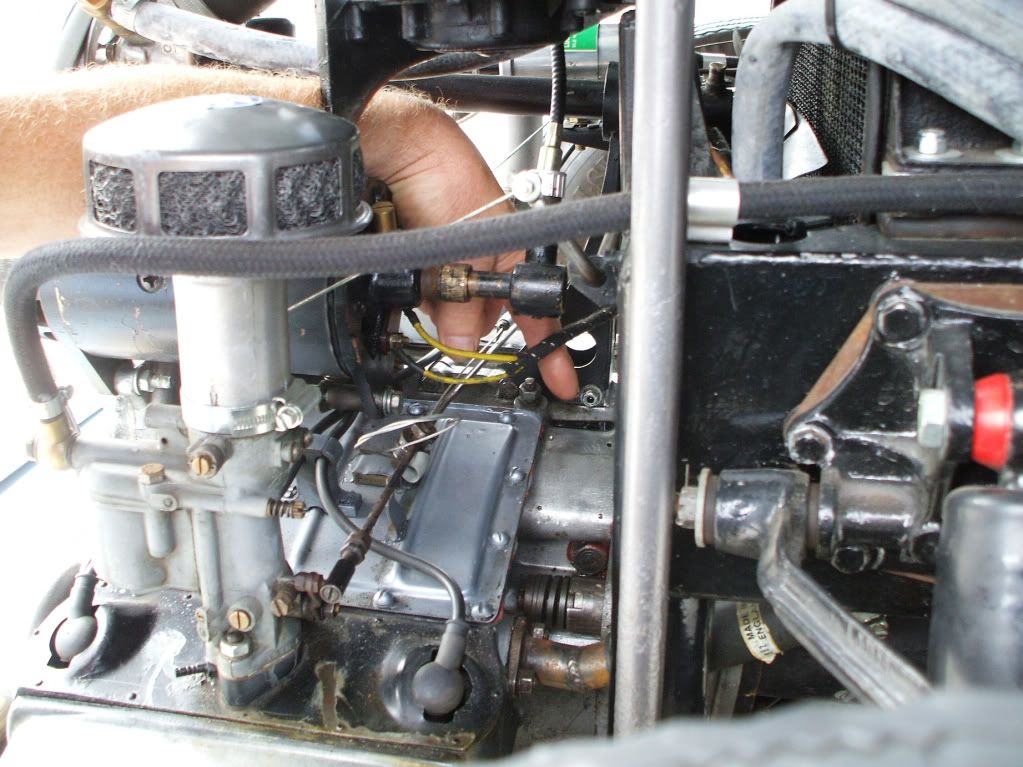
Some of the folk I had the pleasure of talking to at Gaydon may recall that we had a pretty a scary experience on our way down when our newly aquired Jupe broke down in the middle lane of the M60! I'm afraid that has resulted in some reluctance to use the car and it wasn't until this week that the car got a proper outing when I drove the 30 miles or so to work-avoiding all motorways needless to say! Car performed very nicely, but I now have an oil leak-the photo below shows my friend's finger pointing to a small pool in a recess at the back of the engine block where it joins the gearbox-or so I believe!
Thoughts on where this may be eminating from and remedial action suggestions would be much appreciated!
Search on JowettTalk for other topics discussing this. Very common. Most likely is the filter housing gasket (mods available), otherwise oil cooler pipe banjos (take care with these they are easily stripped), filter bowl gasket, oil pressure pipe gland, seal between faces of cylinder block.
As Keith has mentioned, the causes for this very common leak are many and varied. If you want to, just give me a call...my phone number is in the members listing. Probably every Javelin/Jupiter engine has suffered oil leaks in this area over the past 60 years and finally getting them solved will try the patience of a saint!
Never mind, they can be solved and perhpas I can assist with some ideas to try?
I had a similar problem. The engine slopes slightly towards the back and so any leakage seems to find its way to that rear recess on top of the crankcase. Nipping up the banjo bolts solved my leak. As said be carefull, if the thread in the aluminium is stripped you won't get a good seal. Dowty washers can help I understand, Dave gave me some but as yet have not had a further problem so as yet I have not fitted them.
As a member of JCC and JOAC i wish to join to take part in on-line discussion and to improve my knowlege and understanding of the jupiter mark.
Dowty washers (gas filled) are brilliant. I have used them for twenty years. The problem is they are thicker than the fibre ones and so you have to be very careful not to strip the fine thread.
I know . . I may appear to be harping on about this . . . . but, I say DON"T use fibre washers . . anywhere!
They can have a tendency to settle and when/if that happens the item under them will require re-tightening (doing this to the engine' s internal fittings is "awkward" to say the least!). Not only can they compress shortly after fitting but they have been known to split/disintegrate and pop out under pressure of the tightening or the pressure of the fluid they are retaining, especially if they have become oil soaked and softened through being "loose".
Now, these dire situations that I'm warning about may only happen if the material they are made from is rather poor, but I wouldn't risk using any fibre washers, personally.
Use copper or aluminium washers (or the excellent propriety sealing washers that are available - Keith has mentioned Dowty Washers. There are others, but their name escapes me!). Of course these can be re-used time and again if not damaged. Between uses the ordinary washers should be annealed (softened). If not using the propriety washers, copper is probably the preferred material to use as they are so easily annealed by heating to a dull red and then dropping into water. Annealing Aluminium is much more tricky to achieve the annealed state without a complete "meltdown"
Cheers.
Leo.
R. Leo Bolter,
Palmerston North,
New Zealand.
JCC of NZ - Member No 0741.
JOAC - Member No 0161
Car: Jupiter (E1-SA-513-R)
Skype name = jupiter1951
Messenger name = r.l.bolter"at"massey.ac.nz
I agree with Leo. My experience with fibre washers has never been a happy one. For Javelin/Jupiter engines, as Brian has said earlier, I recommend using Dowty washers for the oil bypass banjo unions. So far, with total success.
The main point where we use fibre washers is on the Zenith carb banjos. I am not sure whether you can obtain Dowty washers this small, or whether they would respond well to petrol? However, when using fibre washers here, it is vital to make sure the washers are a really tight fit on the brass screws. I find there is not a stock size that fits well and I have to open up the next size down with a round file. It's worth it though, they can be made leak free and are easy to reach.
The other fibre washer is the one under the oil pressure take-off union, to the rear of the timing rear cover. Here, take extream caution! The brass fitting is a taper thread and can easily cause a split in the thin aluminium boss! This seems to occur underneath the boss and you then get oil leaking into the 'troughs' on top of the engine! The solution we have adopted is to get the rear timing cover welded and re-tapped with a parallel thread, making up a new brass take-off fitting to match the new thread.
This has drifted away from our discussion on fibre washers, but again when using a fibre washer here, it must be a tight fit on the brass fitting. As Leo says, using a soft metal washer would be much safer!
As usual, our engines seem to love leaking oil! Yes, there are a few that seem pristine and dry, but normally they are streaked with oil and we all seem to have a cloth handy to give them a bit of a polish! Unless it gets serious, I reckon we just have to live with a bit of oil.here and there! I buy mine in 25 litre drums and try and smile!
On all my Jupiter engines, I have changed the Banjos to 16mm and tapped out the Rear Timing Cover threads to suit.
This gives increased line size to the Oil Cooler and metric Dowty washers are available.
Incidentally, the same is used for Oil Pump discharge pipe by boring out to suit 1/2" copper. The thread in the Oil pump has to be increased to suit, and the hole face counterbored to suit the Dowty washer.
I normally make a new fitting from brass silver soldered to the other end of the discharge line where it fitted to the block with setscrews.
This is part of the mods to assist oil pressure and oil flow to the crankcase galleries which have been dealt with on other occasions I am sure.
General and Technical Interest. Have Owned Jupiter since 1961.
As one of the founding members of the Jowett Club of Australia (as it was called then) stated:
"A good Jowett squirts it oil thirty feet!"
However, since April 1957, we have come a long way on the oil control front - probably from thirty feet squirts down to isolated dust collecting weeps.
I have theories that some crankcases may be a little bit porous, and that combined with the amount of oil splashing around inside the crankcase at 4,000-plus engine RPM means that weeps can magically appear, where least expected! It happens on Ford tractors too, so we are not alone.
Getting back to the rear timing cover (some call it the oil filter housing) there are a number of leak points. Already mentioned is the taper thread oil pressure pipe union. This brass fitting has a taper that, as mentioned, is capable of splitting the boss that it screws into - as David says, usually at its hidden area.
Looking at your photo, I would say there is a goodly flow coming from somewhere, most likely at the forward end of the engine.
Is the oil pressure OK? If not, there could be a dislodged rear gallery plug, but leakage from there is unlikely with even a Jowett being unable to defy gravity! The rear cavity is wide open to sump.
Oil Pressure Pipe Union Fitting
The best way to resolve oil leakage in this area is to start right from scratch. Remove the water pump to make access easier, remove the engine oil filter canister (that will flood the top of the engine!) and carefully remove the rear timing cover. It may be best to unscrew the top centre stud to make removal easier. Unscrew the taper thread oil pressure union and carefully examine the boss that it screws into. If the boss is split, then it is best to get it welded by a skilled aluminium welder and start again with the taper thread. A good machine shop can do this. When assembling the brass taper fitting into the housing, make sure that both components are scrupulously cleaned, sprayed with Loctite Primer, left for half an hour to dry and etch, and then assemble using Loctite 518 sealant. Tighten the fitting firmly into the housing. There is no requirement for a fibre washer here at all. When tightening the oil pressure pipe union nut, make sure that the fitting in the rear timing cover is securely held with a good-fit spanner and ensure that the taper union fitting is not permitted to turn at all while the pipe union nut is being tightened.
Oil Filter Drain Set Screw
This long threaded setscrew is located in the right hand side of the rear timing cover. It is usually fitted with a fibre washer. Mostly, these do not leak, but after a few loosening and tightening sequences, that can change dramatically. For this I use an 8 mm Dowty washer. This has been totally successful.
Oil Cooler Pipe Banjo Fittings
I have noted previous mention on these two banjo bolts. First a word of warning -- on the right hand side (looking forward from the driver's seat) there is one of the two clamp down 5/16" BSF bolts that passes right by the lower oil cooler port. This has happened to me before, extreme care should be taken when removing and installing this bolt. The reason for this caution is that a 1/4" Whitworth, 1/2" drive socket can have finger grip knurling (ribs) that, if the socket leans while unscrewing the bolt in a hurry, it can 'mill' out a groove in the soft aluminium boss for the banjo bolt. If this should happen, no amount of tightening against a fibre washer, or a Dowty washer for that matter, will effect an oil tight seal. The boss, if this happens, will need to be spot-faced by a machine shop to clean up the contact surface.
Personally, I have ceased having any faith in fibre washers years ago, more particularly so with such washers made in 'PROC' that seem to break up very easily. I only ever use Dowty washers in this application. A Dowty washer was demonstrated to me whereby it was used under a screwed-in hydraulic union fitting. The fitting was finger tightened against the washer and was then demonstrated to hold more than 1,000 psi fluid pressurewithout leaking. Impressive indeed -- you don't see many oil dripping Airbus aircraft do you?
A Dowty washer is a metal ring section with a lipped rubber seal bonded to the inside diameter. Obviously, the banjo bolt, the banjo fitting and the face of the housing's boss must be flat and smooth, for an effective seal. The main attraction related to these washers is the fact that the banjo bolt only needs to be tightened enough to keep it snugly tight.
The Rear Timing Cover Gasket - Part Number 50692
In recent years, I have completely ditched this gasket. I now cut an aluminium plate (16 SWG) to basically the same shape as the gasket. The oil gallery ports are drilled larger so that a set of hydraulic-quality 'O' rings can be installed in the plate. The idea is for the plate to locate the 'O' rings and provide backup for them against oil pressure that can spike as high as 100-plus psi. Another feature of the plate idea is that it expands and contracts at the same rate as the other components around it, and there is then no conflicting shrinkage between components.
The plate is carefully bent to fit over the top of the crankcase faces with no gaps. The selected 'O' rings should have a ring section that permits a small amount of crush. Too much crush and they will distort into the gallery ports. At the top of the gasket face on the rear timing cover, there is a fore and aft groove. This groove allows for any mismatch there may be at the crankcase set gasket surfaces. Ideally this groove should be filled with a glued-in piece of 'O' ring cord, which is then carefully shaved to the profile of the aluminium plate, with, again, just a small amount of crush.
Installation requires that all parts are absolutely clean. The mating surfaces should then be primed with Loctite Primer and left to dry for half an hour. Note: Use of Loctite Primer can cause the sealant being used to cure too quickly. Loctite advised me to use a final cleaning wipe with methylated spirit, if quick curing can be a concern. It is also important that the two clamp down bolts screw into sound threads in the crankcase set.
Apply a very thin application of Loctite 518 to both faces of the aluminium plate. It should be noted that the Loctite product is anaerobic. That means that it will not cure until all air is excluded from the joint being sealed. This feature has great advantages for the Jowett mechanic.
The upper portion of the front timing cover gasket should be carefully cut back absolutely flush with the faces on the crankcase set. Cut a new timing cover gasket to match properly. When fitting this piece of gasket, be sure to apply a small bead of Loctite 518 between the mating faces. Apply a smear of Loctite 518 to both sides of the front cover gasket. Place the aluminium plate and 'O' rings into position. Make sure there is a smear of Loctite 518 at the outer ends of the plate where it butts against the front cover gasket. Hold the plate forward, so that it is flush with the front edge of the crankcase set, while the rear timing cover is being installed. Once in position, gently tighten the front cover bolts into the rear cover, to hold it forward while it is being tightened down at the two 5/16" bolts. During this operation, keep holding the plate forward. Snug-up all hardware and tighten firmly.
Install the oil cooler banjo fittings with new Dowty washers. Install a new oil filter element and fit the canister against a new sealing ring.
I think that, about twenty (20) potential oil leak points have been identified with respect to the rear timing cover.
Your engine should now be completely oil tight at the rear timing cover, and you can drive your Jupiter with supreme confidence - I do! Peace of mind is paramount in classic motoring.
I have no affiliation with Loctite products at all. Just a good degree of loyalty to a product that has served me well in my work environment. Loctite have always been quick and very helpful when new concerns have arisen. Their products have always worked well for me and the technical support has always been exemplary. That alone breeds loyalty in a product.
By the time you have finished all of the foregoing, it will very likely be time to fix coolant leakage at the water pump. I have a good fix for that too!
Good luck with your oil leak rectification project.
Different topic though. I notice in your photograph that the rear coolant inlet has been modified by welding on an extension to, probably, facilitate the fitting of a short, straight, bottom hose.
Keep an eye on this because reduced vibration and engine rocking motion absorption, via a shortened hose, could cause the outlet elbow to break free from the radiator's bottom tank at the solder joint.
Another wierd cause can be the fan stay studs where they are threaded into the block. Also oil can leak out via the engine block pinch bolts. In both cases it can be cured by removing the offending stud/bolt, and giving them a smear of instant gasket, re-assembling before it dries of course.
Ref my post on 12th Oct... When I say 'fan stay studs' I'm referring to the ones utilised by the Javelin fan stays. A Jup engine will still have these studs, but they serve no purpose, (other than to leak oil perhaps!!! ), as the fan stay assembly is held by the crankcase pinch bolts of course.

 ), as the fan stay assembly is held by the crankcase pinch bolts of course.