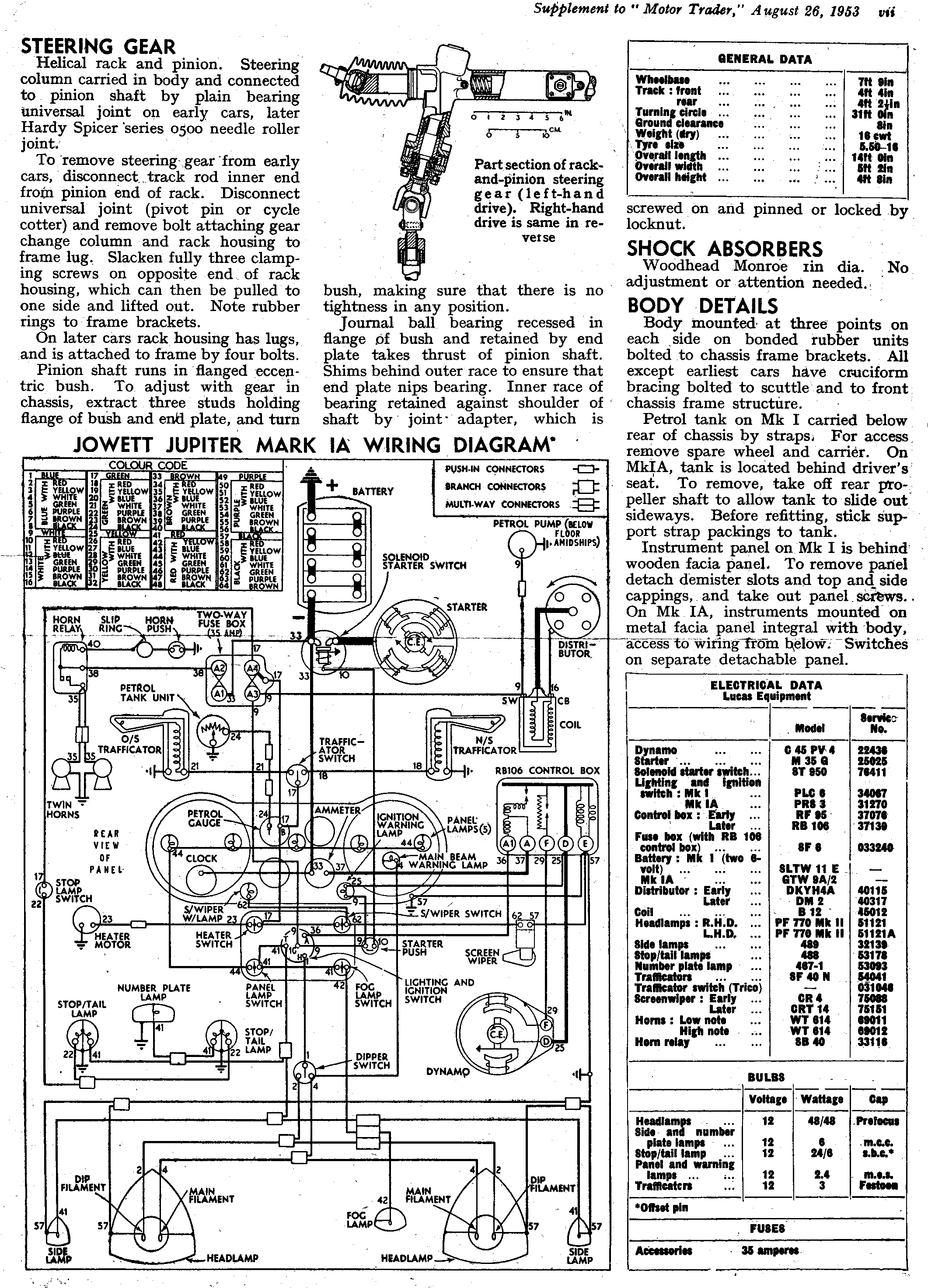
Subsequently from the Motor Trader Bulletin put on the website 20 years ago I snipped the SC Wiring Diagram into the Gallery here and printed it to leave in the glove box of the car for future reference.
SC Wiring diagram
-
Forumadmin
- Site Admin
- Posts: 20684
- Joined: Tue Feb 07, 2006 5:18 pm
- Your interest in the forum: Not a lot!
- Given Name: Forum
SC Wiring diagram
Took the two Jups to a show at Woburn today. But various electric components failed to work. We went straight to the fuse but they both seemed visually OK. Amy consulted the wiring diagram and I went to get the meter. Anyhow, turned out to be a fuse (which was new a couple of years ago) that looked OK but was not. I resoldered it and all now worked. Later Amy went to get some new ones.
Subsequently from the Motor Trader Bulletin put on the website 20 years ago I snipped the SC Wiring Diagram into the Gallery here and printed it to leave in the glove box of the car for future reference.

Subsequently from the Motor Trader Bulletin put on the website 20 years ago I snipped the SC Wiring Diagram into the Gallery here and printed it to leave in the glove box of the car for future reference.
-
ian Howell
- Posts: 967
- Joined: Thu Feb 09, 2006 10:46 am
- Your interest in the forum: From 1962 to '63, CA Bradord LLG 125 (Repaired and used).
From 1966 to '67 Black deLuxe Javelin LDF 738 (Scrapped with broken chassis)
From 1967 to '87 Black de Luxe Javelin MKC 1 (later 6469TU). (Sold as non-runner with tons of spares, 1987)
From about 1980 to '87 ex WD Jowett stationary engine. (Sold on)
From 1966 to present, 1930 Long Four Fabric Saloon, Dark Blue / Black.
Taken in a part-repaired state to the 2010 Centenary Rally, returned to a roadworthy state by 2013. - Given Name: Ian
- Location: Eastbourne, East Sussex, England
- Contact:
Re: SC Wiring diagram
Yes, 'dried out' soldered joints are not an unusual problem in older electrics/electronics.
I have resurrected numerous printed circuits simply by re-melting the soldered joints - even the ones that appeared to be OK.
Another common problem is corroded joints or connections where the circuit is left 'live' for prolonged periods (i.e. 'always live') such as the feed from the battery to the distribution point (fuse box, regulator, cut-out, etc) and of course the positive battery terminal itself. A problem here is that even a minor movement of the component can 'clear' the fault, only for it to reappear at the most inconvenient time.
Another area where corrosion rears its ugly head is where components containing zinc (e.g. door locks and trim bits) are in contact with carbon steel. This sets up a local electrical 'cell' and the weaker component loses the battle, - in this case the zinc.
This feature is used on ships hulls to prevent corrosion of the bronze propellors. A 'sacrificial' zinc anode is bolted to the hull and periodically replaced.
I don't think car manufacturers considered door handles as 'sacrificial' components!
I have resurrected numerous printed circuits simply by re-melting the soldered joints - even the ones that appeared to be OK.
Another common problem is corroded joints or connections where the circuit is left 'live' for prolonged periods (i.e. 'always live') such as the feed from the battery to the distribution point (fuse box, regulator, cut-out, etc) and of course the positive battery terminal itself. A problem here is that even a minor movement of the component can 'clear' the fault, only for it to reappear at the most inconvenient time.
Another area where corrosion rears its ugly head is where components containing zinc (e.g. door locks and trim bits) are in contact with carbon steel. This sets up a local electrical 'cell' and the weaker component loses the battle, - in this case the zinc.
This feature is used on ships hulls to prevent corrosion of the bronze propellors. A 'sacrificial' zinc anode is bolted to the hull and periodically replaced.
I don't think car manufacturers considered door handles as 'sacrificial' components!
The devil is in the detail!
-
Tony Fearn
- Posts: 1745
- Joined: Thu Feb 09, 2006 5:33 pm
- Your interest in the forum: Early pre-wars. Owner of 1933 'Flying Fox' 'Sarah Jane, and 1934 Short saloon 'Mary Ellen'.
- Given Name: Anthony
- Location: Clayton le Moors, Lancashire, the Premier County in the British Isles!!
Re: SC Wiring diagram
I have a battery cut-out on both pre-wars. Would this help to sort the problem?Ian wrote:Another common problem is corroded joints or connections where the circuit is left 'live' for prolonged periods.
Tony.
-
Forumadmin
- Site Admin
- Posts: 20684
- Joined: Tue Feb 07, 2006 5:18 pm
- Your interest in the forum: Not a lot!
- Given Name: Forum
Re: SC Wiring diagram
My take on this is that the 'liveness' of the system would really only have a bearing if there was a leakage current which might occur if there was any moisture around. We are talking here of only micro amps. The more likely explanation of corrosion is the galvanic action of dissimilar substances such as aluminium and steel or bronze and zinc in the presence of some electrolyte such as a weak salt in solution or acid rain.
There is some evidence that positive earth systems suffered worse corrosion than negative earth due to the direction in which ions flowed. There might even be some mileage in considering electric currents formed when cars in motion pass through the earth's magnetic field independent of the car's electric system or static electric currents formed by motion through ionized air or those nylon underpants.
But yes I have switch on all cars to disconnect battery whenever the ignition is switched off. I do not need a working clock or alarm system or parking light.
Dry joints or mechanically weak joints can cause arcing particularly in the rear lamp holders causing extra heating and failure of the filament. Answer is LED bulbs which are now good enough for vehicle applications. They offer multicolour and multi bulb solutions to front and rear light in keeping with the style of the era.
Another interesting fact taught me by Scott was the use of zinc based solder which hardens copper and has caused two failures on my alternator/dynamo connectors. Use crimps not solder.
There is some evidence that positive earth systems suffered worse corrosion than negative earth due to the direction in which ions flowed. There might even be some mileage in considering electric currents formed when cars in motion pass through the earth's magnetic field independent of the car's electric system or static electric currents formed by motion through ionized air or those nylon underpants.
But yes I have switch on all cars to disconnect battery whenever the ignition is switched off. I do not need a working clock or alarm system or parking light.
Dry joints or mechanically weak joints can cause arcing particularly in the rear lamp holders causing extra heating and failure of the filament. Answer is LED bulbs which are now good enough for vehicle applications. They offer multicolour and multi bulb solutions to front and rear light in keeping with the style of the era.
Another interesting fact taught me by Scott was the use of zinc based solder which hardens copper and has caused two failures on my alternator/dynamo connectors. Use crimps not solder.